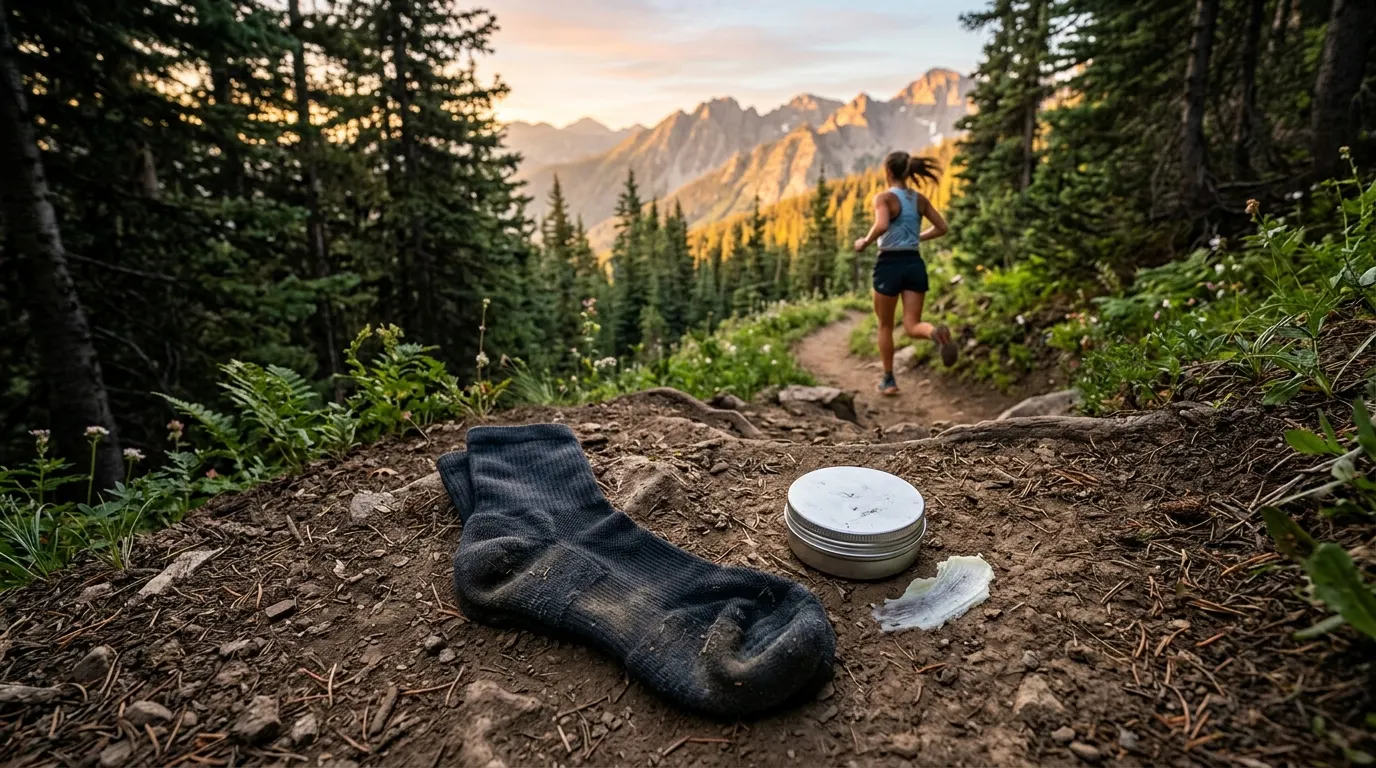
Trail running blisters are almost never random. They cluster at specific contact points for specific mechanical reasons, and each reason has its own fix applied in the right order. A blister that shows up at mile 20 was not caused by a single moment at mile 20; it was caused by sock choice made at home, skin preparation made at the starting line, or a training run two weeks prior that taught your foot a habit. This guide walks through what actually causes trail running blisters, why the sock matters more than most runners think, when toe socks solve a problem that regular socks cannot, and how to apply anti-chafe products so they stay put for 30 hours instead of washing off in the first creek.
Quick answer
Blisters come from three fixable sources: sock fit that bunches, skin-to-skin friction at hotspots, and moisture breaking down skin. Darn Tough Micro Crew Trail Running Socks resists bunching over long efforts. Body Glide Original Anti-Chafe Balm applied before a run prevents hotspot friction. Injinji Trail Midweight Crew Toe Socks toe socks stop inter-toe blisters. Squirrel's Nut Butter Anti-Chafe Salve lasts longer under sweat for multi-day efforts.
This guide contains affiliate links. TrailCadence may earn a commission at no cost to you.
Why trail runners get blisters and what actually causes them
Trail running blisters come from three distinct mechanical causes, and each one requires a different fix. The first is sock failure: a sock that compresses, shifts, or bunches under foot impact over hours, creating wrinkles and friction that regular skin-on-sock contact cannot prevent. The second is skin-on-skin friction at high-sweat areas: inner thighs, underarms, and the back of the neck where a vest harness sits all become raw if not protected. The third is moisture breakdown: skin that is wet for many hours loses its barrier function, and even perfectly fitted equipment chafes a foot or toe that has been inside a damp sock since mile 15.
Most runners blame blisters on distance ("100 miles is just too hard on feet") or bad luck ("my feet are blister-prone"). In reality, experienced ultramarathoners with a consistent kit rarely get blisters at all, while beginners in the same race distance get multiple blisters. The difference is not genetics; it is preventing the three causes in order.
The order matters. A premium sock prevents bunching but cannot prevent skin-to-skin chafe. Anti-chafe lube prevents hotspot friction but cannot prevent a sock from bunching at mile 40. Addressing sock failure first eliminates 60 to 70 percent of trail running blisters before you ever open a lube jar.
Sock fit and density: the first and most important blister prevention tool
The Darn Tough Micro Crew Trail Running Socks prevents blisters through dense Vermont merino construction that resists compressing into wrinkles over long efforts. A standard sock material compresses and bunches under load the same way a pillow does after you sleep on it; the Darn Tough Micro Crew Trail Running Socks knit is tight enough that it maintains its form even after six hours of impact loading. That structural stability eliminates the friction source entirely.
How to assess sock fit and density: put a new sock on and run for 10 minutes, then take it off and look at the inside. The inside surface should have only the imprint of your foot contours; you should not see wrinkles, bunched fabric, or seams that have shifted to strange angles. If the sock shows obvious compression wrinkles after a 10-minute test, it will blister you by mile 30 on a trail run and mile 50 on an ultramarathon. Do not take that sock to a race.
Merino wool outperforms synthetic blends for blisters because wool resists compression better than nylon or polyester, and because merino wicks moisture faster, which prevents the wet-skin breakdown that makes even a well-fitted sock fail late in an effort. The Balega Enduro Quarter Trail Running Socks is a strong runner-up synthetic choice with a seamless toe and faster moisture wicking, but neither the seamless toe nor the wicking matters if the sock has already bunched. Density first; everything else is secondary.

Darn Tough Micro Crew Trail Running Socks
Vermont-made merino wool trail socks with a lifetime guarantee: stays blister-free over long efforts and does not bunch or compress.

Balega Enduro Quarter Trail Running Socks
A moisture-wicking South African mohair blend sock with a DryRelease finish and a seamless toe for long distance comfort.
Skin-to-skin chafe: where to apply anti-chafe and when to reapply
Skin-to-skin friction happens at inner thighs, underarms, and any point where vest straps cross bare skin, and it happens faster in heat and with longer efforts. The Body Glide Original Anti-Chafe Balm applied before the race starts creates a barrier that prevents that friction from starting. Unlike some products that wash off in the first sweat, Body Glide is formulated to hold under heavy moisture.
The application protocol matters as much as the product. Apply anti-chafe to all expected contact zones before you leave the house, not at the starting line where you will be rushed. Inner thighs, the full underarm from armpit to side rib, the back of the neck where a hydration vest sits, the bra line for women, and the top of the foot around the ankle collar of the sock are the five highest-risk zones on a trail run. Coat each zone generously; a thin layer washes off within an hour.
Reapply at any crew point or aid station where you have time, particularly around mile 6 to 8 on a 50K or around mile 25 on a 100-mile. The second application does not need to be as heavy as the first; a quick touch-up to visible exposed skin is enough. By mile 60 on a 100-mile, some runners find Squirrel's Nut Butter Anti-Chafe Salve works better than Body Glide Original Anti-Chafe Balm because it is thicker and lasts longer under extreme sweat, though it is harder to apply during a race stop.

Body Glide Original Anti-Chafe Balm
The anti-chafe category standard: a glide-on balm stick that prevents skin friction at every contact point without greasy residue.

Squirrel's Nut Butter Anti-Chafe Salve
A thick, oil-based anti-chafe salve used by ultramarathon runners who need 12-plus hours of protection without reapplication.
Inter-toe blisters: when toe socks actually solve a problem regular socks cannot
Inter-toe blisters, which form between the toes on the sides of each toe facing its neighbors, are among the most common and most stubborn blister types on trail runs. They happen because feet swell under running load and because toes impact each other on technical descents where foot strike stress transfers sideways into the foot. A regular sock cannot prevent that toe-to-toe contact.
The Injinji Trail Midweight Crew Toe Socks solves this specific problem by placing a fabric wall between each toe that stops skin-on-skin contact. For runners who get inter-toe blisters, they are transformative; for runners who do not, they feel like a gimmick with a break-in period. The key is knowing which camp you are in before a race: test Injinji on a 10-mile run first, and only take them to a race if they fit your foot and feel normal by mile 5.
Injinji work because they address a cause that regular sock density cannot fix. A perfectly fitted regular sock like the Darn Tough Micro Crew Trail Running Socks prevents bunching blisters and hotspot blisters, but it cannot prevent two skin surfaces (adjacent toes) from contact-friction each other. If you have never had an inter-toe blister, the regular sock alone is enough. If inter-toe blisters are your problem, Injinji is the solution.

Injinji Trail Midweight Crew Toe Socks
Individual toe-pocket socks that eliminate inter-toe skin contact: the specialist answer to blisters between toes on long descents.
Darn Tough Micro Crew Trail Running Socks
Vermont-made merino wool trail socks with a lifetime guarantee: stays blister-free over long efforts and does not bunch or compress.
Moisture management: why wet feet blister faster and what prevents it
Skin that is wet for more than a few hours loses its structural integrity and becomes fragile to friction. A Darn Tough Micro Crew Trail Running Socks sock will prevent bunching blisters even when wet, but a wet foot inside a wet sock has already compromised its outer barrier layer, which means blister risk rises dramatically after creek crossings or rain.
The practical response to wet feet on a trail run is not to keep feet dry, because that is often impossible on technical mountain trails with stream crossings. The response is to accept wetness and manage it actively: apply anti-chafe lube on top of the wetness (lube displaces water and forms a barrier anyway), and plan for the fact that blisters are more likely in the hours after a major wetting.
Some experienced ultramarathoners treat significant creek crossings or rain as signal to reapply anti-chafe even if they had already done so. Others carry waterproof socks like GearDry or similar for key creek sections, wear them only for the crossing, and switch back to regular merino socks. For most runners and most efforts, accepting wet feet and reapplying Body Glide Original Anti-Chafe Balm or Squirrel's Nut Butter Anti-Chafe Salve at the next aid station after a creek is enough to prevent wet-skin blister breakdown.
Darn Tough Micro Crew Trail Running Socks
Vermont-made merino wool trail socks with a lifetime guarantee: stays blister-free over long efforts and does not bunch or compress.
Body Glide Original Anti-Chafe Balm
The anti-chafe category standard: a glide-on balm stick that prevents skin friction at every contact point without greasy residue.
Squirrel's Nut Butter Anti-Chafe Salve
A thick, oil-based anti-chafe salve used by ultramarathon runners who need 12-plus hours of protection without reapplication.
The blister prevention priority order: what to fix first
If you have never run more than a marathon or have never blistered before, start with one change: buy a pair of Darn Tough Micro Crew Trail Running Socks and run a 10-mile training run in them to confirm the fit. That single change prevents most trail running blisters because sock failure is the primary cause.
If you sometimes blister despite a good sock choice, add Body Glide Original Anti-Chafe Balm applied to hotspot zones before every long run. That covers skin-to-skin friction prevention. Test the combination on a 20-mile run before committing to a race.
If you specifically get inter-toe blisters, add Injinji Trail Midweight Crew Toe Socks to your kit after testing them on a 10-mile run. They feel different and require a break-in; race day is not the time to figure out if they work for you.
For 100-mile races in hot weather, upgrade anti-chafe to Squirrel's Nut Butter Anti-Chafe Salve for the second half, and plan to reapply at crew points. Squirrel's Nut Butter outlasts Body Glide under extreme sweat and extended effort.
The common mistake is buying every product and expecting that combination to work without testing. Each product solves a specific problem. Buy them in order, test each one, and only add the next after confirming the earlier one works for your body.
Darn Tough Micro Crew Trail Running Socks
Vermont-made merino wool trail socks with a lifetime guarantee: stays blister-free over long efforts and does not bunch or compress.
Body Glide Original Anti-Chafe Balm
The anti-chafe category standard: a glide-on balm stick that prevents skin friction at every contact point without greasy residue.
Injinji Trail Midweight Crew Toe Socks
Individual toe-pocket socks that eliminate inter-toe skin contact: the specialist answer to blisters between toes on long descents.
Squirrel's Nut Butter Anti-Chafe Salve
A thick, oil-based anti-chafe salve used by ultramarathon runners who need 12-plus hours of protection without reapplication.
Darn Tough Micro Crew Trail Running Socks
Vermont-made merino wool trail socks with a lifetime guarantee: stays blister-free over long efforts and does not bunch or compress.
Balega Enduro Quarter Trail Running Socks
A moisture-wicking South African mohair blend sock with a DryRelease finish and a seamless toe for long distance comfort.
Injinji Trail Midweight Crew Toe Socks
Individual toe-pocket socks that eliminate inter-toe skin contact: the specialist answer to blisters between toes on long descents.
Body Glide Original Anti-Chafe Balm
The anti-chafe category standard: a glide-on balm stick that prevents skin friction at every contact point without greasy residue.
Squirrel's Nut Butter Anti-Chafe Salve
A thick, oil-based anti-chafe salve used by ultramarathon runners who need 12-plus hours of protection without reapplication.
FAQ
Frequently asked questions
Do socks actually prevent trail running blisters, or is it all anti-chafe lube?+
Socks prevent most blisters. Anti-chafe lube prevents maybe 20 to 30 percent of the remainder. The reason is mechanical: a sock that compresses or bunches creates friction faster than skin-to-skin friction does, and lube cannot prevent wrinkles from forming. Start with sock choice, then add lube for the specific hotspots that lube actually prevents.
What makes Darn Tough socks different from cheap socks for blister prevention?+
Darn Tough uses a tight, dense merino knit that resists compression under impact loading. Cheap socks use loose weaves and thinner yarn that compress and bunch the same way a pillow does. After a 10-minute test run, a good sock shows only foot-contour imprints inside; a cheap sock shows wrinkles and seams that have shifted. That structural difference is what prevents blisters over 30 to 100 miles.
Do I have to use anti-chafe lube if I have the right socks?+
No, if you do not have skin-to-skin contact hotspots (inner thighs, underarms, vest contact zones). Some runners in the right outfit never apply lube and never blister. Most runners benefit from lube application because trail running includes moisture, sweat, and the heat that makes skin-to-skin friction more likely than in training runs. Lube is cheap insurance.
Are toe socks necessary for trail running, or just for specific blister problems?+
Toe socks are necessary only if you specifically get inter-toe blisters between the toes. If your blisters form on the ball of the foot, heel, or hotspot zones, toe socks will not help and may add complexity. If you consistently blister between toes on long descents, Injinji is a revelation. Test them on a training run first before racing in them.
Should I change socks at a race aid station to prevent blisters?+
Only if your feet are so wet that your socks are visibly holding water and squishing inside your shoe. Changing socks mid-race resets all the friction dynamics and introduces new blister risk from poorly fitted shoes in an unfamiliar sock. Most runners are better off keeping the same socks and letting them dry slightly on your foot as you run. If you do change, apply fresh anti-chafe lube to your feet before putting on the new sock.