
Running 100 miles means running through at least one full night, and on mountain courses often two. Headlamp selection for a 100-miler is not casual gear shopping. You need to calculate runtime against your expected hours of darkness, understand what reactive lighting actually does, know the mandatory kit requirements for your specific race, and make a primary plus backup decision. This guide covers the Petzl Nao RL Headlamp , Petzl Swift RL Headlamp , Black Diamond Spot 400 Headlamp , and Lupine Piko 4 Headlamp for race use.
Quick answer
For 100-mile races, carry the Petzl Nao RL as your primary headlamp (1500 lumens, reactive lighting, roughly 2 hours at sustained max output) and a Black Diamond Spot 400 as your mandatory backup. The Nao RL reactive beam manages battery automatically from daylight to night, and the Spot 400 AAA batteries swap at any drop bag.
This guide contains affiliate links. TrailCadence may earn a commission at no cost to you.
How much runtime do you actually need?
The first step is not choosing a headlamp model; it is calculating your personal darkness exposure. A 100-mile race with a 30-hour cutoff that starts at 5am will have runners at night from roughly hour 14 (7pm) through hour 26 (7am the next day), with a total of 12 to 14 hours of darkness depending on season and latitude.
The Petzl Nao RL Headlamp delivers roughly 2 hours at sustained maximum output (1500 lumens) and many more hours with reactive lighting managing the beam. In a 14-hour overnight segment, reactive lighting will run the lamp at variable output. In practice, experienced runners report 10 to 12 hours of effective use per charge on the Nao RL in mixed race conditions. That is sufficient for overnight segments but tight for a two-night race without a recharge at a drop bag.
Plan for recharging at a crew point or drop bag if you anticipate two full nights. A USB-C power bank at your 70-mile drop bag solves this completely. The Petzl Swift RL Headlamp at 9 hours maximum requires the same planning for two-night events.

Petzl Nao RL Headlamp
1500 lumens with REACTIVE lighting that automatically adjusts output, a rechargeable 3200 mAh battery, and a split-beam design that covers trail and horizon simultaneously.
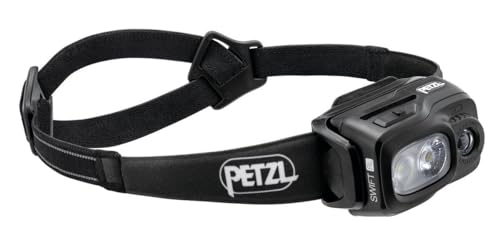
Petzl Swift RL Headlamp
900 lumens reactive lighting in a 73g package: the most lightweight Petzl with REACTIVE technology for runners who count grams.
Reactive lighting: what it does and why it matters in a race
REACTIVE lighting (Petzl trademark term) uses an ambient light sensor to increase beam intensity in dark environments and reduce it in bright ones. It sounds like a minor convenience feature. In a 100-mile race, it solves real problems.
First, it eliminates manual button operations when you are at mile 75, exhausted, and entering an aid station with bright lights and then leaving back into darkness. The lamp adjusts automatically. Second, it conserves battery during dawn and dusk transition periods that can each last an hour on a mountain course. Third, it reduces eye strain by not blasting maximum lumens when you step into a lit aid station tent.
Both the Petzl Nao RL Headlamp and Petzl Swift RL Headlamp include reactive lighting. The Black Diamond Spot 400 Headlamp and Lupine Piko 4 Headlamp do not. For multi-day race use where manual adjustment requires cognitive load you may not have at mile 80, reactive lighting is worth the price premium.
Petzl Nao RL Headlamp
1500 lumens with REACTIVE lighting that automatically adjusts output, a rechargeable 3200 mAh battery, and a split-beam design that covers trail and horizon simultaneously.
Petzl Swift RL Headlamp
900 lumens reactive lighting in a 73g package: the most lightweight Petzl with REACTIVE technology for runners who count grams.

Black Diamond Spot 400 Headlamp
400 lumens, 99g, with IP67 waterproofing and AAA battery backup: the most versatile trail running headlamp for mixed conditions.

Lupine Piko 4 Headlamp
A premium German-made headlamp with 1500 lumens, a secure tri-point head harness, and a detachable battery pack that eliminates head weight.
The backup headlamp requirement: what to carry and why
Nearly every major 100-mile race requires a backup light source in your mandatory kit. UTMB requires a primary and secondary light. Hardrock 100 mandatory kit includes primary and backup lighting. Western States does not mandate a backup but most experienced runners carry one.
The Black Diamond Spot 400 Headlamp is the best backup choice for three reasons: 400 lumens meets any mandatory kit minimum, IP67 waterproofing survives the weather you will encounter between mile 60 and 90, and AAA batteries can be replaced at any point in the race without a charger.
That last point matters more than most runners appreciate. If your primary headlamp fails at mile 72 and your backup runs out of charge at mile 80, you have a genuine emergency. With a AAA backup, you can get new batteries from any aid station crew, SAG vehicle, or drop bag. Rechargeable-only backups eliminate this option.
Keep the Black Diamond Spot 400 Headlamp in your vest, not in your drop bag. You can lose power at a stretch where your next drop bag is 20 miles away.
Black Diamond Spot 400 Headlamp
400 lumens, 99g, with IP67 waterproofing and AAA battery backup: the most versatile trail running headlamp for mixed conditions.
Fit at running pace: why bounce ruins performance
A headlamp that bounces on a trail run is not just annoying; it degrades vision meaningfully because the beam oscillates with each stride instead of illuminating a stable field. At mile 90 on a technical rocky section, a bouncing lamp creates a strobing effect that makes rock placement harder to judge.
The single-band design used by the Petzl Nao RL Headlamp and Petzl Swift RL Headlamp works only if the band is positioned correctly. The band must run under the occipital bone at the back of the skull, not over the crown of the head. Most bounce complaints from running headlamps come from incorrect band placement rather than inherent design flaws.
Wearing the headlamp over a running cap significantly reduces bounce for any model. The cap fabric grips the lamp against the head and the cap brim presses it forward. This is the field trick used by experienced runners when their lamp is slightly too loose.
The Lupine Piko 4 Headlamp solves the bounce problem structurally with a three-point harness that encircles the head at three contact points instead of one. The result is zero bounce at running pace. The tradeoff is setup time and the cable between lamp and battery pack.
Petzl Nao RL Headlamp
1500 lumens with REACTIVE lighting that automatically adjusts output, a rechargeable 3200 mAh battery, and a split-beam design that covers trail and horizon simultaneously.
Petzl Swift RL Headlamp
900 lumens reactive lighting in a 73g package: the most lightweight Petzl with REACTIVE technology for runners who count grams.
Lupine Piko 4 Headlamp
A premium German-made headlamp with 1500 lumens, a secure tri-point head harness, and a detachable battery pack that eliminates head weight.
Lumens by section: when you need the most output
Not all nighttime trail running requires maximum output. On a wide fire road or a well-marked trail through forest at moderate pace, 300 to 400 lumens is sufficient. The Black Diamond Spot 400 Headlamp is genuinely adequate here.
The situations that demand 1000 lumens or more: technical rocky terrain at night where rockhopping requires seeing 6 to 10 meters ahead to process and react in time, fast descents on open mountain terrain where the beam must illuminate far enough ahead to set up foot placement, and aid station departure into sudden darkness where the eyes have not adapted.
The Petzl Nao RL Headlamp at 1500 lumens reactive gives you full output when the trail demands it and conserves battery when it does not. For a section like the canyon descent at Western States or a technical mountain section at UTMB Mont Blanc, maximum output is a genuine safety matter.
Petzl Nao RL Headlamp
1500 lumens with REACTIVE lighting that automatically adjusts output, a rechargeable 3200 mAh battery, and a split-beam design that covers trail and horizon simultaneously.
Black Diamond Spot 400 Headlamp
400 lumens, 99g, with IP67 waterproofing and AAA battery backup: the most versatile trail running headlamp for mixed conditions.
Petzl Nao RL Headlamp
1500 lumens with REACTIVE lighting that automatically adjusts output, a rechargeable 3200 mAh battery, and a split-beam design that covers trail and horizon simultaneously.
Petzl Swift RL Headlamp
900 lumens reactive lighting in a 73g package: the most lightweight Petzl with REACTIVE technology for runners who count grams.
Black Diamond Spot 400 Headlamp
400 lumens, 99g, with IP67 waterproofing and AAA battery backup: the most versatile trail running headlamp for mixed conditions.
Lupine Piko 4 Headlamp
A premium German-made headlamp with 1500 lumens, a secure tri-point head harness, and a detachable battery pack that eliminates head weight.
FAQ
Frequently asked questions
What is the minimum lumen requirement for major 100-mile races?+
UTMB-category races typically require 200 lumens minimum for the backup and do not specify a primary minimum. Hardrock 100 and Western States have similar general requirements. Check your specific race mandatory kit list in the year you are running it, because requirements are updated annually. Having 400 lumens as a backup exceeds any current requirement and provides genuine margin.
Can I charge my headlamp at a 100-mile race drop bag?+
Yes, if you plan for it. Put a USB-C power bank at your 70-mile drop bag and charge the Petzl Nao RL during any sit-down crew stop. A 30-minute charge can add several hours of runtime. The Black Diamond Spot 400 backup does not need this because it runs on replaceable AAA batteries. Planning your charging stops is part of race night planning, the same as planning your headlamp on and off times relative to sunset and sunrise.
Does running with a headlamp cause neck or head strain over hours?+
A heavy headlamp creates noticeable head weight and slight forward neck pull over many hours of running. The Petzl Nao RL at 145g sits at the upper end of running-headlamp weight, while the Petzl Swift RL at 73g is light enough that most runners do not notice head weight even at mile 80. The Lupine Piko detachable battery pack solves the weight problem by moving battery mass to the torso. Headlamps over 150g cause measurable neck fatigue on efforts over 12 hours of continuous wear.