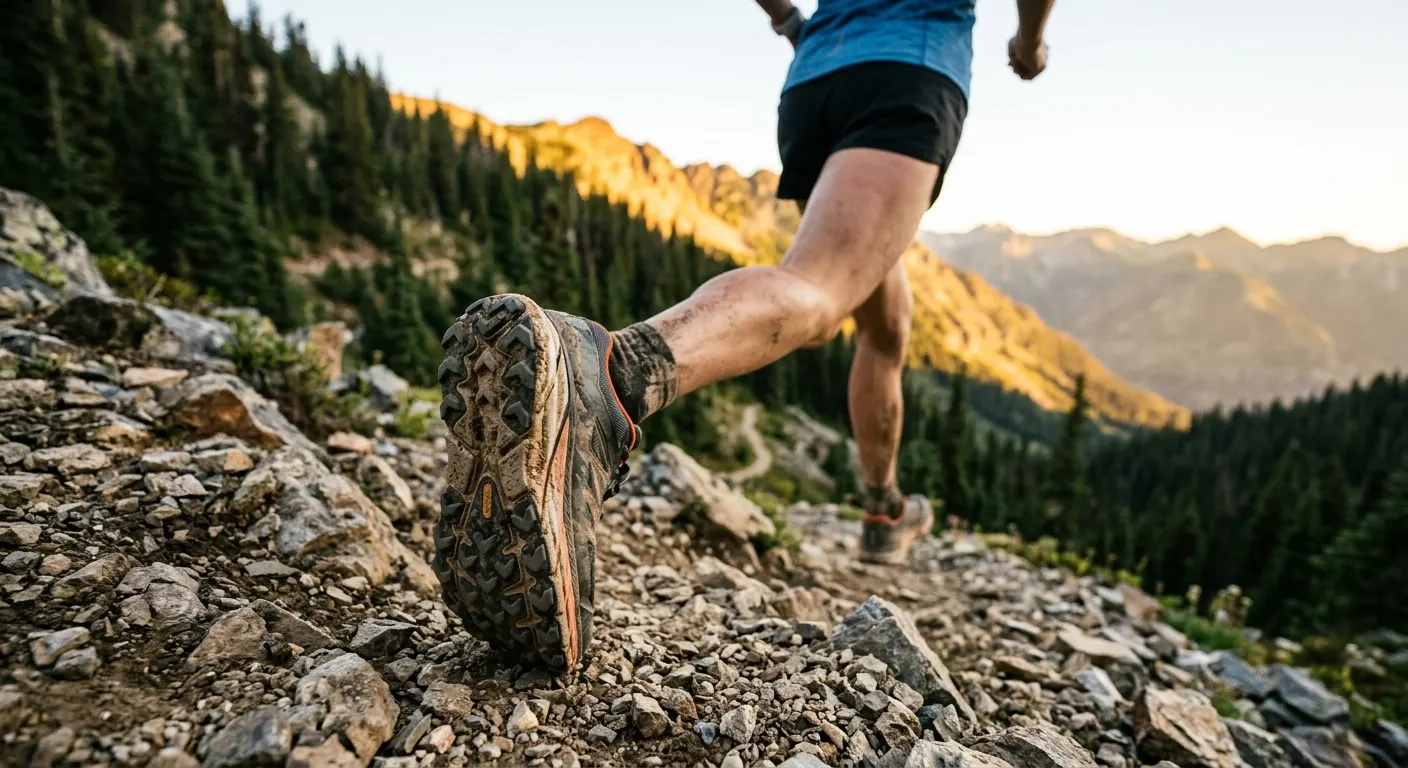
Trail shoe specifications read like a spec sheet that few brands explain in plain language. Drop, stack, lug depth, and rockplate presence all affect how the shoe performs underfoot, but the numbers are meaningless without knowing what they mean for your terrain and distance. This guide explains each spec clearly and maps it to real shoes: the Hoka Speedgoat 6 Trail Running Shoe , Salomon Speedcross 6 Trail Running Shoe , Saucony Peregrine 14 Trail Running Shoe , Brooks Cascadia 17 Trail Running Shoe , Altra Lone Peak 8 Trail Running Shoe , and Salomon S/LAB Ultra 3 Trail Running Shoe .
Quick answer
Drop is the heel-to-toe height difference and affects running form; most trail runners do best at 4-8mm. Stack height is total midsole thickness and determines cushion; maximally cushioned shoes like the Hoka Speedgoat 6 (about 40mm stack) protect on long rocky efforts. Lug depth determines mud traction; 4-6mm lugs handle wet trail, under 3mm suits hard dry ground.
This guide contains affiliate links. TrailCadence may earn a commission at no cost to you.
Heel-to-toe drop: what it is and what it does
Drop is the difference in height between the heel and the forefoot of the shoe. A 0mm drop shoe ( Altra Lone Peak 8 Trail Running Shoe ) places the heel and forefoot at the same height, encouraging a flatter landing. An 8mm drop shoe ( Brooks Cascadia 17 Trail Running Shoe ) raises the heel, which suits runners accustomed to road shoe geometry.
Drop is not cushion. A high-drop shoe can have a minimal stack, and a zero-drop shoe can have a maximal stack. What drop affects is ankle angle at landing, Achilles loading, and how much forefoot versus heel strike the shoe encourages.
The practical advice: do not change drop dramatically without a transition period. Going from 10mm road shoes to 0mm overnight causes Achilles tendinopathy and calf strain reliably. If you are moving to lower drop, drop 2mm per month and run shorter distances in the new shoe first. The Altra Lone Peak 8 Trail Running Shoe at 0mm requires the most careful transition; the Hoka Speedgoat 6 Trail Running Shoe at 5mm is the most accessible low-drop entry for road runners moving to trail.

Altra Lone Peak 8 Trail Running Shoe
The zero-drop wide-toe-box trail standard: foot-shaped last, zero heel-to-toe drop, and a MaxTrac outsole for most terrain types.

Hoka Speedgoat 6 Trail Running Shoe
The most popular high-cushion trail shoe in ultramarathon running: maximal Hoka stack, Vibram Megagrip outsole, and 5mm drop.

Brooks Cascadia 17 Trail Running Shoe
A versatile everyday trail trainer with a 8mm drop, TrailTack rubber outsole, and a medium-width fit that works for more foot shapes than Salomon or Hoka.
Stack height: cushion, protection, and ground feel
Stack height is the total thickness of the midsole and outsole under the foot. High-stack shoes (Hoka Speedgoat 6 at about 40mm rear / 35mm front) give maximum protection on rocky terrain and reduce muscular fatigue on long descents. Low-stack shoes give more ground feel and proprioceptive feedback.
The case for high stack on ultras is well-established. Quad fatigue on 100-mile descents is significantly reduced by cushion, and rocks that would bruise a low-stack shoe pass through a maximal midsole without impact. The Hoka Speedgoat 6 Trail Running Shoe and New Balance Fresh Foam X More Trail v3 represent the maximal end. The Saucony Peregrine 14 Trail Running Shoe and Salomon S/LAB Ultra 3 Trail Running Shoe are lower stack, performance-oriented options.
Ground feel matters on technical scrambling where foot placement precision is more important than cushion. Technical mountain runners at UTMB use the Salomon S/LAB Ultra 3 Trail Running Shoe partly for this reason: the shoe communicates terrain more directly than a maximal stack allows. This is a tradeoff, not a free upgrade.
Hoka Speedgoat 6 Trail Running Shoe
The most popular high-cushion trail shoe in ultramarathon running: maximal Hoka stack, Vibram Megagrip outsole, and 5mm drop.

New Balance Fresh Foam X More Trail v3
Maximum cushion trail shoe with New Balance Fresh Foam X stack, a 4mm drop, and Vibram outsole for runners wanting Hoka-level protection at a slightly lower price.

Saucony Peregrine 14 Trail Running Shoe
A nimble technical trail shoe with 4mm lugs, a 4mm drop, and a TPU rock plate that punches above its weight for rocky terrain.
Salomon S/LAB Ultra 3 Trail Running Shoe
The shoe worn on UTMB podiums: an ultra-responsive Vibe midsole, EN Soles technology, and 3mm lugs optimized for fast mountain terrain.
Lug depth: matching outsole to terrain
Lug depth is the protrusion height of the outsole knobs from the base of the outsole. Deep lugs ( Salomon Speedcross 6 Trail Running Shoe at 6mm) dig into soft mud and eject debris. Shallow lugs (under 3mm) work on hard dry trails and compact dirt. The wrong lug depth for conditions can be more dangerous than no lugs at all; shallow lugs on deep mud pack out immediately.
The general guide: soft, wet, muddy conditions use 4 to 6mm deep lugs. The Salomon Speedcross 6 Trail Running Shoe is the benchmark here. Mixed wet and dry trails use 3 to 4mm lugs, which describes the Saucony Peregrine 14 Trail Running Shoe and the Hoka Speedgoat 6 Trail Running Shoe . Hard-packed dry trails and fire roads use 2 to 3mm lugs where a deeper lug feels clunky and slow.
Lug spacing matters as much as depth. Close-spaced lugs load up with mud and lose traction. The Salomon Speedcross 6 Trail Running Shoe uses an aggressive chevron pattern with wide spacing to eject mud efficiently. Check both depth and spacing pattern when selecting for muddy conditions.
Salomon Speedcross 6 Trail Running Shoe
The mud-traction benchmark: 6mm lug depth, aggressive chevron tread, and a snug sensifit that locks the foot for technical terrain.
Saucony Peregrine 14 Trail Running Shoe
A nimble technical trail shoe with 4mm lugs, a 4mm drop, and a TPU rock plate that punches above its weight for rocky terrain.
Hoka Speedgoat 6 Trail Running Shoe
The most popular high-cushion trail shoe in ultramarathon running: maximal Hoka stack, Vibram Megagrip outsole, and 5mm drop.
Rockplates: when do you need one?
A rockplate is a rigid insert in the midsole that deflects sharp rocks and reduces stone bruising. The Saucony Peregrine 14 Trail Running Shoe , Brooks Cascadia 17 Trail Running Shoe , and Salomon S/LAB Ultra 3 Trail Running Shoe all include rockplates of varying rigidity.
Rockplates matter most on sharp, rocky terrain with angular stones rather than rounded gravel. On terrain like the talus fields above treeline at Hardrock 100, a shoe without a rockplate will leave you limping by the second day. On softer trails, a rockplate adds slight weight and marginally reduces proprioceptive feedback.
The Hoka Speedgoat 6 Trail Running Shoe manages rock deflection through midsole thickness rather than a traditional rigid rockplate, which maintains some ground feel while still providing protection. Both approaches work; the rockplate is simply more effective on the sharpest possible terrain.
Saucony Peregrine 14 Trail Running Shoe
A nimble technical trail shoe with 4mm lugs, a 4mm drop, and a TPU rock plate that punches above its weight for rocky terrain.
Brooks Cascadia 17 Trail Running Shoe
A versatile everyday trail trainer with a 8mm drop, TrailTack rubber outsole, and a medium-width fit that works for more foot shapes than Salomon or Hoka.
Hoka Speedgoat 6 Trail Running Shoe
The most popular high-cushion trail shoe in ultramarathon running: maximal Hoka stack, Vibram Megagrip outsole, and 5mm drop.
Salomon S/LAB Ultra 3 Trail Running Shoe
The shoe worn on UTMB podiums: an ultra-responsive Vibe midsole, EN Soles technology, and 3mm lugs optimized for fast mountain terrain.
Matching specs to your race
For a 50K on mixed forest trails with occasional mud: Brooks Cascadia 17 Trail Running Shoe or Saucony Peregrine 14 Trail Running Shoe are the all-purpose picks. Both handle most conditions without specializing in anything.
For a 100-mile on rocky high-altitude terrain (Hardrock, Western States, UTMB): the Hoka Speedgoat 6 Trail Running Shoe is the most popular choice for cushion over distance. Experienced technical runners who prioritize response choose the Salomon S/LAB Ultra 3 Trail Running Shoe .
For a muddy autumn 50K in the UK or Pacific Northwest: Salomon Speedcross 6 Trail Running Shoe is the correct specialist tool. Carrying one pair of Speedcross and one pair of Speedgoat for mixed-weather training covers nearly every trail running scenario.
For wide-footed runners regardless of terrain: Altra Lone Peak 8 Trail Running Shoe is the non-negotiable starting recommendation before any other spec matters.
Brooks Cascadia 17 Trail Running Shoe
A versatile everyday trail trainer with a 8mm drop, TrailTack rubber outsole, and a medium-width fit that works for more foot shapes than Salomon or Hoka.
Saucony Peregrine 14 Trail Running Shoe
A nimble technical trail shoe with 4mm lugs, a 4mm drop, and a TPU rock plate that punches above its weight for rocky terrain.
Hoka Speedgoat 6 Trail Running Shoe
The most popular high-cushion trail shoe in ultramarathon running: maximal Hoka stack, Vibram Megagrip outsole, and 5mm drop.
Salomon S/LAB Ultra 3 Trail Running Shoe
The shoe worn on UTMB podiums: an ultra-responsive Vibe midsole, EN Soles technology, and 3mm lugs optimized for fast mountain terrain.
Salomon Speedcross 6 Trail Running Shoe
The mud-traction benchmark: 6mm lug depth, aggressive chevron tread, and a snug sensifit that locks the foot for technical terrain.
Altra Lone Peak 8 Trail Running Shoe
The zero-drop wide-toe-box trail standard: foot-shaped last, zero heel-to-toe drop, and a MaxTrac outsole for most terrain types.
Hoka Speedgoat 6 Trail Running Shoe
The most popular high-cushion trail shoe in ultramarathon running: maximal Hoka stack, Vibram Megagrip outsole, and 5mm drop.
Salomon Speedcross 6 Trail Running Shoe
The mud-traction benchmark: 6mm lug depth, aggressive chevron tread, and a snug sensifit that locks the foot for technical terrain.
Saucony Peregrine 14 Trail Running Shoe
A nimble technical trail shoe with 4mm lugs, a 4mm drop, and a TPU rock plate that punches above its weight for rocky terrain.
Brooks Cascadia 17 Trail Running Shoe
A versatile everyday trail trainer with a 8mm drop, TrailTack rubber outsole, and a medium-width fit that works for more foot shapes than Salomon or Hoka.
Altra Lone Peak 8 Trail Running Shoe
The zero-drop wide-toe-box trail standard: foot-shaped last, zero heel-to-toe drop, and a MaxTrac outsole for most terrain types.
Salomon S/LAB Ultra 3 Trail Running Shoe
The shoe worn on UTMB podiums: an ultra-responsive Vibe midsole, EN Soles technology, and 3mm lugs optimized for fast mountain terrain.
New Balance Fresh Foam X More Trail v3
Maximum cushion trail shoe with New Balance Fresh Foam X stack, a 4mm drop, and Vibram outsole for runners wanting Hoka-level protection at a slightly lower price.
FAQ
Frequently asked questions
What drop is best for trail running beginners?+
Start at the drop of your current road training shoes and decrease gradually. If you run in standard road shoes at 8-10mm drop, the Brooks Cascadia 17 at 8mm is the easiest trail transition. The Hoka Speedgoat at 5mm is accessible for runners who are already running low drop on roads. Zero-drop Altra shoes require a dedicated transition period and should not be chosen as a first trail shoe unless you already run zero drop.
Does high stack height make me more likely to roll an ankle?+
The research does not consistently support this fear. While higher stack height raises the foot center of gravity, the midsole compression that happens at landing mitigates most instability. Ankle stability comes primarily from ankle strength and proprioception, not shoe height. Runners who do lateral movement drills and single-leg balance work have significantly lower ankle roll rates than shoe stack height predicts. Do not choose a low-stack shoe purely out of ankle stability concern.
Can I use trail shoes on the road?+
Yes, but trail lugs wear faster on pavement, and the stiff outsole feels harder underfoot than road-specific cushioning. Most trail runners who do mixed training rotate a road shoe for easy pavement miles and save trail shoes for off-road terrain. This extends the life of both pairs significantly, since trail outsoles dull quickly on asphalt and the investment in a quality pair is meaningful.