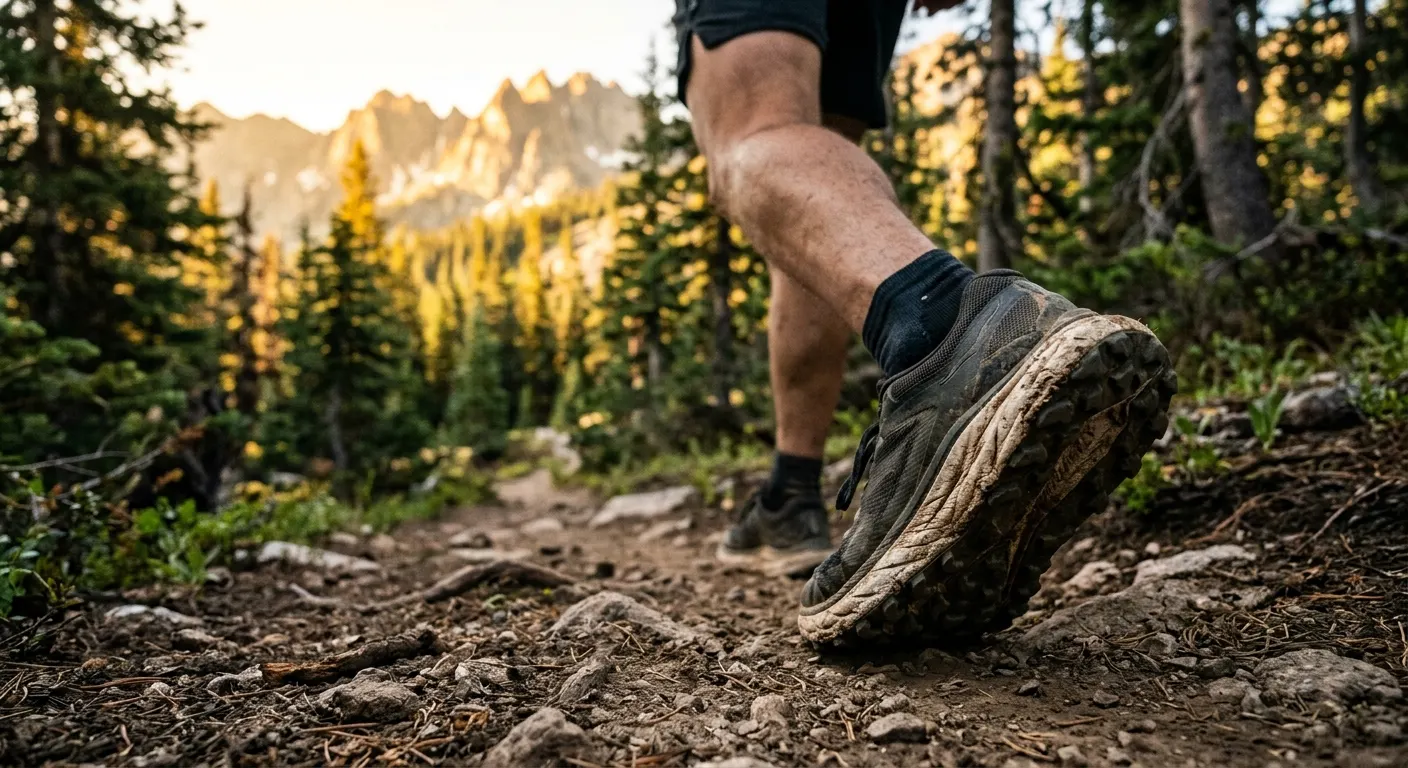
A trail shoe rarely announces its own death. The outsole can still look fine while the midsole underneath has already lost most of its protective cushioning, which means mileage alone is not a reliable retirement signal. This guide walks through brand mileage guidance, the midsole compression test, the visual and physical symptoms that show up before a shoe looks worn, and what to replace it with, using the Brooks Cascadia 17 Trail Running Shoe, Hoka Speedgoat 6 Trail Running Shoe, Altra Lone Peak 8 Trail Running Shoe, Salomon Speedcross 6 Trail Running Shoe, Saucony Peregrine 14 Trail Running Shoe, New Balance Fresh Foam X More Trail v3, and Salomon S/LAB Ultra 3 Trail Running Shoe as reference points. If you have not read our guide to trail shoe drop, stack, and lug depth yet, that one covers how to pick a shoe; this one covers when to stop trusting the pair you already have.
Quick answer
Replace trail shoes every 300 to 500 miles per brand guidance, or sooner if the midsole creases at rest, the toe box flexes loosely, or new aches appear on familiar runs. A 1985 American Journal of Sports Medicine study found shock absorption falls to about 67 percent of new by 100 to 150 miles, well before outsoles look worn.
This guide contains affiliate links. TrailCadence may earn a commission at no cost to you.
How many miles should a trail shoe actually last?
Most running shoe brands, including Brooks and Hoka, publish 300 to 500 miles as their general mileage guidance before a shoe's midsole has lost enough cushioning to justify replacement, though the true useful life depends heavily on runner weight, terrain, and stride pattern.
A Brooks Cascadia 17 Trail Running Shoe used mostly on soft forest singletrack by a lighter runner will sit toward the top of that range. A Salomon Speedcross 6 Trail Running Shoe run through wet grit, sand, and mud wears its outsole faster because abrasive debris grinds down rubber independent of the midsole clock underneath, which is why lug wear and midsole compression need to be checked separately rather than assumed to track together.
Treat 300 to 500 miles as the point where you start checking the shoe carefully, not the point where you automatically retire it. Some runners get 600 miles from a durable pair; others feel a shoe go flat by mile 250 on technical, rocky terrain that loads the midsole harder per mile than smooth trail.

Brooks Cascadia 17 Trail Running Shoe
A versatile everyday trail trainer with a 8mm drop, TrailTack rubber outsole, and a medium-width fit that works for more foot shapes than Salomon or Hoka.

Salomon Speedcross 6 Trail Running Shoe
The mud-traction benchmark: 6mm lug depth, aggressive chevron tread, and a snug sensifit that locks the foot for technical terrain.
What does a midsole compression test reveal before the shoe looks worn?
The New Balance Fresh Foam X More Trail v3 and every other maximal-foam trail shoe follow the same compression curve that Cook, Kester, and Brunet documented in a 1985 American Journal of Sports Medicine study: shock absorption fell to about 67 percent of new by 100 to 150 miles.
The practical version of that finding is a simple thumb test: press firmly into the heel and forefoot foam and watch how quickly it springs back. Foam that stays dented, or that feels noticeably harder and less springy than it did when new, has already lost meaningful shock absorption even if the mileage total looks reasonable.
Compare the test shoe against a new pair of the same model if you have access to one at a store. The difference in give under thumb pressure is usually obvious once you have a fresh baseline to compare against, and it tells you more than a mileage estimate ever will.

New Balance Fresh Foam X More Trail v3
Maximum cushion trail shoe with New Balance Fresh Foam X stack, a 4mm drop, and Vibram outsole for runners wanting Hoka-level protection at a slightly lower price.
What does permanent midsole creasing look like, and why does it matter?
A permanent crease across the forefoot flex zone of a Hoka Speedgoat 6 Trail Running Shoe or Saucony Peregrine 14 Trail Running Shoe, visible when the shoe sits flat and unloaded, means the midsole foam has lost its structural memory and will not spring back on the next stride.
High-stack shoes like the Speedgoat 6 tend to show a different symptom first: visible side-wall leaning or compression at the heel, because there is more total foam volume to break down before creasing shows through at the flex point. Lower-stack shoes like the Peregrine 14 crease sooner and more visibly, simply because there is less material buffering the flex zone.
Either symptom means the same thing underneath: the EVA or foam compound has taken a permanent set. A crease that disappears when you pick the shoe up and flex it is normal; a crease that stays visible at rest is not.

Hoka Speedgoat 6 Trail Running Shoe
The most popular high-cushion trail shoe in ultramarathon running: maximal Hoka stack, Vibram Megagrip outsole, and 5mm drop.

Saucony Peregrine 14 Trail Running Shoe
A nimble technical trail shoe with 4mm lugs, a 4mm drop, and a TPU rock plate that punches above its weight for rocky terrain.
What symptoms show up before the shoe looks broken?
Runners logging most of their miles in a zero-drop Altra Lone Peak 8 Trail Running Shoe often notice a familiar ache, most commonly in the shins, the knee, or the arch, return on a run they have done many times without issue: an early symptom of midsole breakdown.
This happens because compressed foam changes the ground reaction force pattern your body has already adapted to. Calf or Achilles tightness returning once the platform's cushioning compresses means the shoe now effectively behaves stiffer than it did when new, even though the drop itself has not changed.
Do not dismiss a new ache as a training-load problem without first checking the shoe. If the soreness shows up specifically on runs in one particular pair and not in a second pair of the same model, the shoe is very likely the variable that changed.

Altra Lone Peak 8 Trail Running Shoe
The zero-drop wide-toe-box trail standard: foot-shaped last, zero heel-to-toe drop, and a MaxTrac outsole for most terrain types.
How much lug wear is too much to trust on technical terrain?
A Salomon Speedcross 6 Trail Running Shoe with lug depth worn to roughly half its original 6mm height, easiest to judge by holding it next to a new pair, can no longer bite into mud, wet rock, or loose scree the way it did when new.
Once Speedcross 6 lugs wear down to roughly 3mm, the shoe still functions but loses the mud-specific traction advantage that justified choosing it in the first place. The Saucony Peregrine 14 Trail Running Shoe ships with shallower 4mm lugs meant for mixed and rockier trail, so its usable range runs out around 2mm of remaining depth.
Lug wear and midsole compression do not always fail on the same schedule. A shoe can have plenty of midsole cushioning left with worn-out lugs, in which case it is still fine for dry, hard-packed trail even though it should be retired from muddy or technical terrain.
Salomon Speedcross 6 Trail Running Shoe
The mud-traction benchmark: 6mm lug depth, aggressive chevron tread, and a snug sensifit that locks the foot for technical terrain.
Saucony Peregrine 14 Trail Running Shoe
A nimble technical trail shoe with 4mm lugs, a 4mm drop, and a TPU rock plate that punches above its weight for rocky terrain.
What should you buy to replace a worn-out trail shoe?
A fresh pair of the same Brooks Cascadia 17 Trail Running Shoe or Hoka Speedgoat 6 Trail Running Shoe you already wore out is usually the safest replacement, because your body has already adapted to its drop, stack, and lug pattern, and swapping models resets that adaptation period.
If the old pair never fit quite right, use the replacement as the moment to fix it. Wide-footed runners who fought a narrow toe box should move to the Altra Lone Peak 8 Trail Running Shoe. Runners who want Hoka-level cushion at a slightly lower price point can try the New Balance Fresh Foam X More Trail v3. Experienced technical runners upgrading from a general trail shoe toward something built for fast, rocky mountain terrain should look at the Salomon S/LAB Ultra 3 Trail Running Shoe.
For the full breakdown of drop, stack height, and lug depth so a new pair matches your terrain and distance instead of just replacing the old spec by default, see our guide to trail shoe drop, stack, and lug depth explained.
Brooks Cascadia 17 Trail Running Shoe
A versatile everyday trail trainer with a 8mm drop, TrailTack rubber outsole, and a medium-width fit that works for more foot shapes than Salomon or Hoka.
Hoka Speedgoat 6 Trail Running Shoe
The most popular high-cushion trail shoe in ultramarathon running: maximal Hoka stack, Vibram Megagrip outsole, and 5mm drop.
Altra Lone Peak 8 Trail Running Shoe
The zero-drop wide-toe-box trail standard: foot-shaped last, zero heel-to-toe drop, and a MaxTrac outsole for most terrain types.
New Balance Fresh Foam X More Trail v3
Maximum cushion trail shoe with New Balance Fresh Foam X stack, a 4mm drop, and Vibram outsole for runners wanting Hoka-level protection at a slightly lower price.
Salomon S/LAB Ultra 3 Trail Running Shoe
The shoe worn on UTMB podiums: an ultra-responsive Vibe midsole, EN Soles technology, and 3mm lugs optimized for fast mountain terrain.
Does rotating two pairs of trail shoes extend their life?
Rotating two pairs, for example a cushioned Hoka Speedgoat 6 Trail Running Shoe for long easy days and a lighter Saucony Peregrine 14 Trail Running Shoe for technical or faster runs, gives each pair's midsole foam time to recover some of its rebound between runs rather than compressing under back-to-back daily loading.
The compression research on midsole shock absorption supports this indirectly: foam that gets a rest period between compressions tends to hold its structure longer than foam compressed on consecutive days without recovery time. Rotation will not double a shoe's total mileage life, but it does spread wear across two pairs and gives you a built-in comparison point for spotting compression in either one.
Hoka Speedgoat 6 Trail Running Shoe
The most popular high-cushion trail shoe in ultramarathon running: maximal Hoka stack, Vibram Megagrip outsole, and 5mm drop.
Saucony Peregrine 14 Trail Running Shoe
A nimble technical trail shoe with 4mm lugs, a 4mm drop, and a TPU rock plate that punches above its weight for rocky terrain.
Do your socks need replacing at the same time as your shoes?
Fresh socks such as Balega Enduro Quarter Trail Running Socks or a toe-specific Injinji Trail Midweight Crew Toe Socks matter most exactly when you replace a shoe, because a compressed old midsole and a new shoe's firmer fit create pressure points your feet have not dealt with before.
New shoes and old, worn-in socks are a common mismatch. The sock has molded to the shape of the old shoe's now-compressed footbed, and a new shoe with fresh, firmer cushioning underneath changes how the sock sits against the foot. Break in a new shoe with fresh socks on shorter runs before trusting the combination for race day or a long training run.

Balega Enduro Quarter Trail Running Socks
A moisture-wicking South African mohair blend sock with a DryRelease finish and a seamless toe for long distance comfort.

Injinji Trail Midweight Crew Toe Socks
Individual toe-pocket socks that eliminate inter-toe skin contact: the specialist answer to blisters between toes on long descents.
Brooks Cascadia 17 Trail Running Shoe
A versatile everyday trail trainer with a 8mm drop, TrailTack rubber outsole, and a medium-width fit that works for more foot shapes than Salomon or Hoka.
Hoka Speedgoat 6 Trail Running Shoe
The most popular high-cushion trail shoe in ultramarathon running: maximal Hoka stack, Vibram Megagrip outsole, and 5mm drop.
Altra Lone Peak 8 Trail Running Shoe
The zero-drop wide-toe-box trail standard: foot-shaped last, zero heel-to-toe drop, and a MaxTrac outsole for most terrain types.
Salomon Speedcross 6 Trail Running Shoe
The mud-traction benchmark: 6mm lug depth, aggressive chevron tread, and a snug sensifit that locks the foot for technical terrain.
Saucony Peregrine 14 Trail Running Shoe
A nimble technical trail shoe with 4mm lugs, a 4mm drop, and a TPU rock plate that punches above its weight for rocky terrain.
New Balance Fresh Foam X More Trail v3
Maximum cushion trail shoe with New Balance Fresh Foam X stack, a 4mm drop, and Vibram outsole for runners wanting Hoka-level protection at a slightly lower price.
Salomon S/LAB Ultra 3 Trail Running Shoe
The shoe worn on UTMB podiums: an ultra-responsive Vibe midsole, EN Soles technology, and 3mm lugs optimized for fast mountain terrain.
Balega Enduro Quarter Trail Running Socks
A moisture-wicking South African mohair blend sock with a DryRelease finish and a seamless toe for long distance comfort.
Injinji Trail Midweight Crew Toe Socks
Individual toe-pocket socks that eliminate inter-toe skin contact: the specialist answer to blisters between toes on long descents.
FAQ
Frequently asked questions
How many miles do trail running shoes last?+
Most brands, including Brooks and Hoka, publish 300 to 500 miles as general mileage guidance before a trail shoe midsole has lost enough cushioning to justify replacement. Heavier runners and runners on technical, rocky terrain tend to land at the lower end of that range because each mile loads the midsole harder. Lighter runners on smoother trail can often push toward the upper end. Mileage is a starting checkpoint for inspection, not an automatic retirement date.
Can you tell a trail shoe is worn out just by looking at it?+
Not reliably. A 1985 American Journal of Sports Medicine study by Cook, Kester, and Brunet found shock absorption drops to roughly 67 percent of new by 100 to 150 miles, well before most outsoles show visible wear. The midsole compression test, pressing a thumb into the foam and checking rebound, catches this decline earlier than a visual check of the outsole alone.
What is the fastest way to check if a trail shoe needs replacing?+
Run the five-minute inspection above: check total mileage against brand guidance, press-test the midsole foam for rebound, look for a permanent crease at the forefoot flex zone while the shoe sits unloaded, compare remaining lug depth to a new pair, and flex the upper and midsole by hand for cracking or separation. Any one of these failing on its own is a reasonable signal to start shopping for a replacement.
Should I replace both trail shoes in a pair at the same time?+
Yes. Both shoes in a pair accumulate essentially the same mileage and load history, so if one shows midsole compression or permanent creasing, the other is very likely close behind even if it looks slightly better. Replacing only one shoe creates an uneven platform between your left and right foot, which can introduce new asymmetric loading and soreness rather than solve the original problem.
Does worn-out lug tread mean the whole shoe needs replacing?+
Not necessarily. Lug wear and midsole compression can happen on different schedules. A shoe like the Salomon Speedcross 6 that has worn its 6mm lugs down to roughly 3mm may still have usable midsole cushioning left; it has simply lost the deep-mud traction that justified the model choice in the first place. That shoe can often keep serving as a dry-trail or road-crossover pair while a fresh pair takes over on wet or technical terrain, as long as the midsole compression test and creasing check still come back clean.